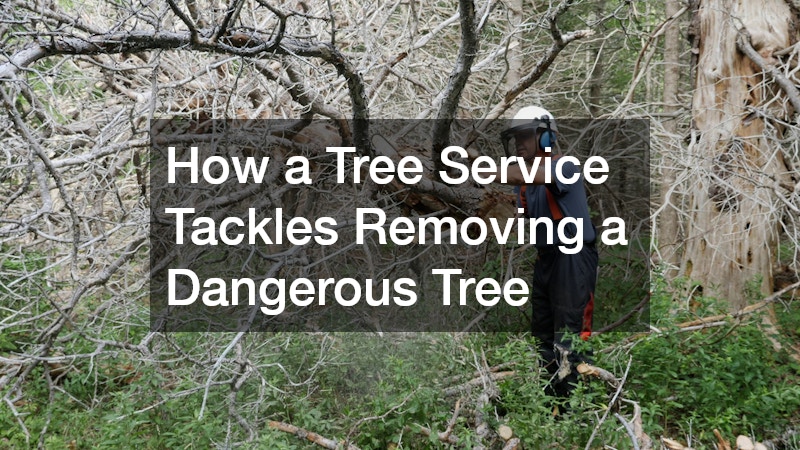
Removing a hazardous tree is one of the most technically demanding tasks in arboriculture. What looks like a straightforward cutting job from the ground often involves complex risk assessment, structural evaluation, and precise execution to prevent damage to nearby property or injury. A professional tree company approaches this process with a methodical plan that prioritizes safety at every stage while minimizing disruption to the surrounding landscape. Understanding how these operations unfold helps clarify why dangerous removals are rarely suitable for DIY approaches and why specialized training and equipment are essential.
The first step in addressing a dangerous tree is a comprehensive site inspection. Arborists evaluate the tree’s structural integrity, looking for signs such as trunk decay, root instability, fungal growth, or large dead limbs that could fail unexpectedly.
Video Source
They also consider external factors like soil conditions, slope, proximity to buildings, and overhead utilities.
This assessment is not limited to the tree itself. Surrounding hazards are mapped out to determine potential fall zones and identify areas that must be secured or avoided during the removal process. Wind exposure and weather conditions are also factored in, since they can significantly alter how a compromised tree behaves during cutting operations.
In many cases, the evaluation reveals that the tree is more unstable than it initially appears. Internal rot, for example, may not be visible externally but can dramatically weaken the structure. These findings inform the removal strategy and help determine whether sectional dismantling or full felling is the safest approach.
Once the hazards are fully understood, a detailed removal plan is developed. A professional tree company will typically choose between two primary methods: complete directional felling, if space allows, or sectional dismantling, which involves removing the tree in smaller, controlled pieces. The latter is more common in residential or urban environments where precision is critical.
The planning phase also includes establishing exclusion zones and setting up safety barriers. These zones ensure that people, pets, and property remain protected throughout the operation. Rigging systems, ropes, and pulleys are selected based on the tree’s size, weight distribution, and condition. Each cut is pre-calculated to control movement and reduce unpredictable shifts in weight.
Crew coordination is essential at this stage. Each team member is assigned a specific role, from climber to ground support, ensuring clear communication and efficient execution. The goal is to eliminate uncertainty before any cutting begins, reducing the likelihood of accidents or collateral damage.
During the execution phase, climbers or aerial lift operators begin the process of removing the tree in controlled segments. Cuts are made strategically to manage load distribution and maintain stability as sections are removed. In cases where the tree is severely compromised, additional rigging is used to guide falling limbs safely to the ground.
Ground crews play an equally important role by managing debris as it comes down. Logs and branches are lowered in a controlled manner to prevent impact damage. Equipment such as wood chippers and cranes may be used depending on the scale of the job and accessibility of the site.
Throughout the process, constant communication ensures that each step proceeds safely. Adjustments are made in real time if the tree behaves unpredictably or if hidden structural weaknesses are discovered during cutting. This adaptability is critical when working with unstable trees that may not respond as expected.
After the tree has been fully removed, cleanup begins immediately. Debris is processed, the site is cleared of wood and branches, and the area is inspected for remaining hazards such as exposed roots or unstable ground. The objective is to return the property to a safe and usable condition without leaving behind residual risk.
Removing a dangerous tree is a highly specialized operation that requires careful planning, technical skill, and strict adherence to safety protocols. From initial inspection through final cleanup, each phase is designed to manage risk and ensure controlled outcomes even under unpredictable conditions. A qualified tree company brings the expertise and equipment necessary to handle these challenges efficiently, reducing the likelihood of property damage and personal injury. In the end, successful removal is not just about cutting wood but about executing a precise and coordinated process that prioritizes safety above all else.